Corned Beef Is What Cut of Meat
 Cooked corned beefiness | |
| Alternative names | Salt beef, bully beef (if canned) |
|---|---|
| Primary ingredients | Beef, salt |
| Variations | Adding sugar and spices |
| |
 Cookbook: Corned beef
 Media: Corned beef
Corned beef, or table salt beef in the Commonwealth of Nations, is table salt-cured brisket of beef.[1] The term comes from the treatment of the meat with large-grained rock salt, also called "corns" of salt. Sometimes, sugar and spices are added to corned beef recipes. Corned beefiness is featured as an ingredient in many cuisines.
Near recipes include nitrates, which convert the natural myoglobin in beef to nitrosomyoglobin, giving it a pink color. Nitrates and nitrites reduce the risk of unsafe botulism during curing by inhibiting the growth of Clostridium botulinum leaner spores,[2] merely have been linked to increased cancer chance in mice.[3] Beef cured without nitrates or nitrites has a grayness color, and is sometimes called "New England corned beef".[4]
Corned beefiness was a pop meal throughout numerous wars, including Earth State of war I and World War II, during which fresh meat was rationed. It as well remains popular worldwide as an ingredient in a variety of regional dishes and as a common role in modern field rations of various armed services around the earth.
History [edit]
Although the exact origin of corned beefiness is unknown, it most likely came near when people began preserving meat through salt-curing. Evidence of its legacy is credible in numerous cultures, including ancient Europe and the Center East.[v] The word corn derives from Sometime English and is used to describe whatever small, hard particles or grains.[6] In the case of corned beef, the word may refer to the coarse, granular salts used to cure the beefiness.[five] The discussion "corned" may also refer to the corns of potassium nitrate, too known as saltpeter, which were formerly used to preserve the meat.[7] [8] [ix]
19th century Atlantic merchandise [edit]
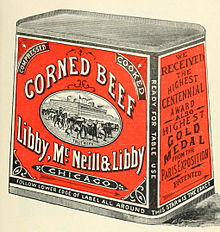
Libby, McNeill & Libby Corned Beef, 1910
Although the practice of curing beef was found locally in many cultures, the industrial production of corned beefiness started in the British Industrial Revolution. Irish corned beef was used and traded extensively from the 17th century to the mid-19th century for British civilian consumption and as provisions for the British naval fleets and North American armies due to its nonperishable nature.[10] The product was as well traded to the French, who used it in their colonies in the Caribbean area equally sustenance for both the colonists and enslaved labourers.[11] The 17th century British industrial processes for corned beef did not distinguish between different cuts of beef beyond the tough and undesirable parts such as the beef necks and shanks.[11] [12] Rather, the grading was done by the weight of the cattle into "pocket-size beef", "cargo beef" and "best mess beef", the former existence the worst and the latter the best.[11] Much of the undesirable portions and lower grades were traded to the French, while improve parts were saved for consumption in Britain or her colonies.[eleven]

Ireland produced a significant amount of the corned beef in the Atlantic trade from local cattle and salt imported from the Iberian Peninsula and southwestern France.[eleven] Coastal cities, such equally Dublin, Belfast and Cork, created vast beef curing and packing industries, with Cork producing half of Ireland'south almanac beef exports in 1668.[12] Although the production and trade of corned beefiness as a commodity was a source of great wealth for the nations of Europe, in the colonies the product was looked upon with disdain due to its consumption by the poor and slaves.[11]
Increasing corned beef product to satisfy the rise number of people moving to the cities from the countryside during the Industrial Revolution worsened the effects of the Irish Dearth of 1740-41 and the Not bad Irish Famine:
The Celtic grazing lands of ... Ireland had been used to pasture cows for centuries. The British colonized ... the Irish gaelic, transforming much of their countryside into an extended grazing land to raise cattle for a hungry consumer market at domicile ... The British taste for beef had a devastating impact on the impoverished and disenfranchised [the] people of ... Ireland. Pushed off the best pasture land and forced to farm smaller plots of marginal state, the Irish gaelic turned to the white potato, a crop that could be grown abundantly in less favourable soil. Somewhen, cows took over much of Ireland, leaving the native population virtually dependent on the white potato for survival.
Despite being a major producer of beef, well-nigh of the people of Ireland during this period consumed little of the meat produced, in either fresh or salted form, due to its prohibitive toll. This was because most of the farms and their produce were owned past wealthy Anglo-Irish gaelic landlords (many of whom were often absent) and most of the population were from families of poor tenant farmers, with most of the corned beefiness being marked for export.[ citation needed ]
The lack of beefiness or corned beef in the Irish nutrition was especially true in the north of Ireland and areas away from the major centres for corned beef production. Still, individuals living in these production centres such as Cork did consume the production to a sure extent. The majority of Irish who resided in Ireland at the fourth dimension mainly consumed dairy products and meats such as pork or salt pork,[12] bacon and cabbage being a notable example of a traditional Irish meal.
20th century to present [edit]

Corned beef became a less important commodity in the 19th century Atlantic world, due in role to the abolition of slavery,[11] Corned beefiness production and its canned form remained an important food source during the 2nd Earth War. Much of the canned corned beef came from Fray Bentos in Uruguay, with over 16 meg cans exported in 1943.[12] Today pregnant amounts of the global canned corned beef supply comes from Due south America. Approximately 80% of the global canned corned beef supply originates in Brazil.[14]
Cultural associations [edit]
In North America, corned beef dishes are associated with traditional British, Irish, and Jewish cuisines. [xv]
Mark Kurlansky, in his volume Common salt, states that the Irish produced a salted beefiness around the Middle Ages that was the "forerunner of what today is known as Irish corned beef" and in the 17th century, the English named the Irish salted beef "corned beef".[16]
Before the wave of 19th century Irish immigration to the United states of america, many of the ethnic Irish did not swallow corned beefiness dishes. The popularity of corned beef compared to back bacon among the immigrant Irish may accept been due to corned beefiness existence considered a luxury product in their native state, while it was cheap and readily available in America.[12]
The Jewish population produced similar corned beef brisket, also smoking it into pastrami. Irish gaelic immigrants often purchased corned beef from Jewish butchers. This substitution was an case of the close interactions in everyday life of people from these two cultures in the United States' main 19th and 20th century immigrant port of entry, New York City.[12] [17]
Canned corned beef has long been one of the standard meals included in military field ration packs globally, due to its simplicity and instant preparation. One instance is the American Repast, Ready-to-Consume (MRE) pack. Astronaut John Young sneaked a contraband corned beef sandwich on board Gemini 3, hiding information technology in a pocket of his spacesuit.[18]
Regions [edit]
Northward America [edit]

In the United States and Canada, corned beef is typically bachelor in two forms: a cut of beef (usually brisket, but sometimes round or silverside) cured or pickled in a seasoned alkali, or cooked and canned.
Corned beef is often purchased ready to swallow in Jewish delicatessens. It is the key ingredient in the grilled Reuben sandwich, consisting of corned beef, Swiss cheese, sauerkraut, and One thousand Island or Russian dressing on rye bread. Smoking corned beef, typically with a more often than not similar spice mix, produces smoked meat (or "smoked beef") such as pastrami or Montreal-style smoked meat.
Corned beef hashed with potatoes served with eggs is a common breakfast dish in the U.s. of America.
In both the United States and Canada, corned beefiness is sold in cans in minced class. It is as well sold this way in Puerto Rico and Uruguay.
Newfoundland and Labrador [edit]
Corned beef is known specifically as "salt beef" in Newfoundland and Labrador, and is sold in buckets with brine to preserve the beef. It is a staple product culturally in Newfoundland and Labrador, providing a source of meat during their long winters. It is still commonly eaten in Newfoundland and Labrador, most ofttimes associated with the local Jiggs dinner meal. In recent years it has been used in different meals locally, such as a Jiggs dinner poutine dish.
Saint Patrick's Day [edit]
In the United States, consumption of corned beef is often associated with Saint Patrick's Day.[19] Corned beef is not an Irish national dish, and the connexion with Saint Patrick's Day specifically originates as part of Irish-American culture, and is ofttimes role of their celebrations in North America.[20]
Corned beef was used as a substitute for bacon by Irish immigrants in the late 19th century.[21] Corned beefiness and cabbage is the Irish-American variant of the Irish dish of bacon and cabbage. A similar dish is the New England boiled dinner, consisting of corned beefiness, cabbage, and root vegetables such as carrots, turnips, and potatoes, which is popular in New England and another like dish, Jiggs dinner, is popular in parts of Atlantic Canada.
Europe [edit]
Republic of ireland [edit]

Corned beef dinner, with potatoes and cabbage, Ireland
The appearance of corned beefiness in Irish cuisine dates to the 12th century in the verse form Aislinge Meic Con Glinne or The Vision of MacConglinne.[22] Within the text, information technology is described as a effeminateness a king uses to purge himself of the "demon of gluttony". Cattle, valued as a bartering tool, were only eaten when no longer able to provide milk or to work. The corned beef as described in this text was a rare and valued dish, given the value and position of cattle inside the civilisation, as well equally the expense of salt, and was unrelated to the corned beef eaten today.[23]
United Kingdom [edit]
In the U.k., "corned beef" refers to minced and canned common salt beef. Unminced corned beef is referred to as salt beef.[ citation needed ]
Latin America [edit]
Caribbean area [edit]
Multiple Caribbean area nations take their own varied versions of canned corned beef as a dish, common in Puerto Rico, Jamaica, Barbados, and elsewhere.[24] With cans being less perishable, it's an effective food to import to tropical islands that will go on, despite the oestrus and humidity. Corned beefiness is a inexpensive, quick, and familiar low-endeavor comfort food that might exist prepared for any meal of the day. As with other cuisines, cooks oft improvise to add extra flavouring components (ordinarily what they have around or left over) to their corned beef, including: onions, garlic, ketchup, black pepper, salt, oil (or other fat), corn, potatoes, tomatoes, cabbage, carrots, beans, hot and/or bell peppers, etc. It'south very often served with a starch, such equally rice, roti, staff of life, or potatoes. Due to its simplicity, many Caribbean children grow upwards thinking fondly of this dish.
Center E [edit]
Israel [edit]
In Israel, a canned corned beef called Loof was the traditional field ration of the Israel Defence force Forces until the product'southward discontinuation in 2011. The name Loof derives from "a colloquially corrupt short form of 'meatloaf.'"[25] Loof was developed by the IDF in the late 1940s as a kosher form of bully beef, while similar canned meats had before been an important component of relief packages sent to Europe and Palestine past Jewish organizations such as Hadassah.[25]
Eastern asia [edit]
Hong Kong [edit]
Corned beef has likewise get a mutual dish in Hong Kong cuisine, though it has been heavily adjusted in style and grooming to fit local tastes. It is often served with other "Western" fusion cuisine at cha chaan teng and other cheap restaurants catering to locals. Similar well-nigh localized "Western" food in East Asia, trade, imperialism, and state of war played roles in bringing and popularizing corned beefiness in Hong Kong.
Southeast Asia [edit]
Philippines [edit]

Along with other canned meats, canned corned beefiness is a pop breakfast staple in the Philippines.[26] [27] Corned beef is also known as carne norte (alternative spelling: karne norte) locally, literally translating to "northern meat" in Spanish, the term refers to Americans, whom Filipinos referred and so every bit norteamericanos, simply similar the rest of Spain's colonies, where there is a differentiation between what is norteamericano (Canadian, American, Mexicano) as there are between centroamericano (Nicaraguense, Costarricense et al.) and sudamericano (Colombiano, Equatoriano, Paraguayo, et al.). The colonial mindset stardom then of what was norteamericano was countries due north of the Viceroy'south Road | Camino de Virreyes, the route used to transport appurtenances from the Manila Galleon landing in the port of Acapulco overland for Havana via the port of Veracruz (and non the Rio Grande river in Texas today), thus centroamericano meant the other Spanish possessions due south of United mexican states city.

Filipino sopas (macaroni soup) with corned beef
Corned beef, especially the Libby'south brand first became pop during the American colonial period of the Philippines (1901–1941), where just the very rich could beget such tins; they were advertised serving the corned beef cold and direct-from-the-can on to a bed of rice, or as patties in betwixt bread. During World War Ii (1942–1945), American soldiers brought for themselves, and airdropped from the skies the aforementioned corned beefiness; it was a life-or-death commodity since the Japanese Imperial Ground forces forcibly controlled all food in an endeavour to subvert whatever resistance confronting them.

Carne norte guisado of the Philippines with potatoes, onions, garlic, carrots, and tomatoes; it is eaten with white rice or bread
Subsequently the war (1946 to present), corned beef gained far more popularity. It remains a staple in balikbayan boxes and Filipino breakfast tables. The ordinary Filipino tin can beget them, and many brands have sprung up, including those manufactured by Century Pacific Nutrient, CDO Foodsphere and San Miguel Food and Beverage, which are wholly owned past Filipinos and locally manufactured.[26] [27]
Philippine corned beef is typically made from shredded beef or buffalo meat, and is virtually exclusively sold in cans. It is boiled, shredded, canned, and sold in supermarkets and grocery stores for mass consumption. It is usually served every bit the breakfast combination called "corned beef silog", in which corned beef is cooked as carne norte guisado (fried, mixed with onions, garlic, and often, finely cubed potatoes, carrots, tomatoes, and/or cabbage), with a side of sinangag (garlic fried rice), and a fried egg.[28] [26] [29] Another common way to swallow corned beef is tortang carne norte (or corned beef omelet), in which corned beef is mixed with egg and fried.[xxx] [31] Corned beef is likewise used equally a inexpensive meat ingredient in dishes like sopas and sinigang.[32] [33] [34]
Oceania [edit]
New Zealand [edit]
In New Zealand, both the canned and fresh varieties are referred to as corned beefiness; fresh corned beef is well-nigh always fabricated with silverside; "silverside" and "corned beef" are often used interchangeably. Canned corned beef is especially popular among New Zealand's Polynesian community, as in Pacific island nations such as Samoa and Tonga; this is due to high-fat foods such equally corned beefiness, known as pisupo in Samoan.
See also [edit]
- Potted meat – Form of traditional food preservation
- Potted meat food product
References [edit]
- ^ "Corned Beef". www.merriam-webster.com . Retrieved September 17, 2021.
- ^ U.s. Dept of Agronomics. "Clostridium botulinum" (PDF) . Retrieved December 13, 2016.
- ^ "Ingested Nitrates and Nitrites, and Cyanobacterial Peptide Toxins". NCBI.NLM.NIH.gov. International Agency for Enquiry on Cancer. Retrieved August 6, 2018.
- ^ Ewbank, Mary (March fourteen, 2018). "The Mystery of New England'southward Gray Corned Beefiness". Atlas Obscura . Retrieved July 22, 2019.
- ^ a b McGee, Harold (2004). On Nutrient and Cooking: The Science and lore of the Kitchen. Simon and Schuster. ISBN978-0-684-80001-1.
- ^ "Corn, n.1". Oxford English Lexicon. Oxford University Printing. 2010. "A pocket-sized difficult particle, a grain, equally of sand or common salt."
- ^ Norris, James F. (1921). A Textbook of Inorganic Chemical science for Colleges. New York: McGraw-Hill. p. 528. OCLC 2743191.
Potassium nitrate is used in the manufacture of gunpowder ... It is also used in curing meats; it prevents putrefaction and produces the deep ruby color familiar in the case of salted hams and corned beef.
- ^ Theiss, Lewis Edwin (January 1911). "Every Solar day Foods That Hurt Health". Pearson'south Magazine. New York: Pearson Pub. Co. 25: 249.
you take probably noticed how nice and ruddy corned beef is. That's considering information technology has in it saltpeter, the same stuff that is used in making gunpowder.
- ^ Hessler, John C.; Smith, Albert L. (1902). Essentials of Chemical science. Boston: Benj. H. Sanborn & Co. p. 158.
The chief utilize of potassium nitrate as a preservative is in the preparation of 'corned' beef.
- ^ Cook, Alexander (2004). "Sailing on The Send: Re-enactment and the Quest for Popular History". History Workshop Journal. 57 (57): 247–255. doi:10.1093/hwj/57.1.247. hdl:1885/54218. JSTOR 25472737. S2CID 194110027.
- ^ a b c d due east f 1000 Mandelblatt, Bertie (2007). "A Transatlantic Article: Irish Salt Beef in the French Atlantic Earth". History Workshop Journal. 63 (ane): 18–47. doi:ten.1093/hwj/dbm028. JSTOR 25472901. S2CID 140660191.
- ^ a b c d east f Mac Con Iomaire, Máirtín; Óg Gallagher, Pádraic (2011). "Irish Corned Beefiness: A Culinary History". Periodical of Culinary Science and Technology. nine (1): 27–43. doi:x.1080/15428052.2011.558464. S2CID 216138899.
- ^ Rifkin, Jeremy (March one, 1993). Beyond Beefiness: The Rise and Fall of the Cattle Culture. Plume. pp. 56, 57. ISBN978-0-452-26952-1.
- ^ Palmeiras, Rafael (September 9, 2011). "Carne enlatada brasileira representa 80% practice consumo mundial". Brasil Econômico. Archived from the original on May 18, 2015. Retrieved May 11, 2015.
- ^ "The History Behind All Your Favorite St. Patrick'south Twenty-four hours Foods". February 27, 2019.
- ^ Kurlansky, Mark (2002). Common salt: A World History . New York: Penguin. pp. 124–127. ISBN978-0-14-200161-v.
- ^ Brownish, Alton (2007). "Pickled Pink". Good Eats. Food network. 10 (xviii).
- ^ Fessenden, Marissa (March 25, 2015). "That Time an Astronaut Smuggled a Corned Beef Sandwich To Space". Smithsonian.com.
- ^ "Is corned beef and cabbage an Irish dish? No! Find out why..." European Cuisines. Retrieved August 29, 2010.
- ^ Lam, Francis (March 17, 2010). "St. Patrick's Day controversy: Is corned beefiness and cabbage Irish?". Salon.com . Retrieved August 29, 2010.
- ^ "St. Patrick'due south Day Traditions". history.com.
- ^ "Aislinge Meic Con Glinne". The University Higher Cork Ireland.
- ^ "Republic of ireland: Why Nosotros Have No Corned Beef & Cabbage Recipes". European Cuisines.
- ^ "Puerto Rican Canned Corned Beef Stew".
- ^ a b Soclof, Adam (November 23, 2011). "As IDF bids goodbye to Loof, a history of 'kosher Spam'". JWeekly.com.
- ^ a b c Makalintal, Bettina (January 4, 2019). "Palm Corned Beef is My Favorite Part of Filipino Breakfast". vice.com.
- ^ a b "Why corned beefiness isn't just for breakfast". cnnphilippines.com. January 26, 2018.
- ^ Manalo, Lalaine. "Ginisang Corned Beef". Kawaling Pinoy . Retrieved January 4, 2022.
- ^ "Corned Beefiness with Potato". Casa Baluarte Filipino Recipes . Retrieved January four, 2022.
- ^ "Tortang Carne Norte Tortang Carne Norte". Overseas Pinoy Cooking . Retrieved Jan iv, 2022.
- ^ "Corned Beef Omelet". Panlasang Pinoy . Retrieved Jan 4, 2022.
- ^ "Sinigang na Corned Beef Recipe". What To Eat Philippines . Retrieved January four, 2022.
- ^ "Sinigang na Corned Beef". Ang Sarap . Retrieved Jan iv, 2022.
- ^ Angeles, Mira. "Sopas with Corned Beefiness Recipe". Yummy.ph . Retrieved January 4, 2022.
gillenwaterlodire.blogspot.com
Source: https://en.wikipedia.org/wiki/Corned_beef

Post a Comment for "Corned Beef Is What Cut of Meat"